
The 2026 Multistate Cyclospora Outbreak
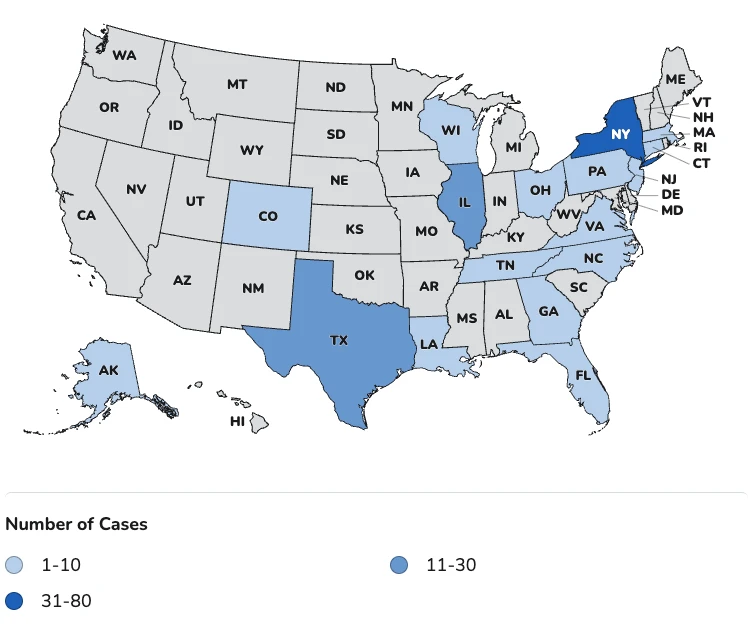
A summer outbreak of Cyclospora, a parasite spread through contaminated food, has made people sick from coast to coast. The CDC reports at least 145 laboratory-confirmed illnesses across 17 states, with 20 people hospitalized and no deaths, among those who got sick between May 1 and June 16, 2026. As of early July, investigators still hadn’t identified the contaminated food.
If a stubborn stomach illness has kept you close to a bathroom for weeks, you’re not imagining how serious it feels. Cyclospora can drag on for a month or more, and it doesn’t always respond to rest and fluids the way ordinary food poisoning does.
What the CDC Has Confirmed
The CDC’s figures come from cases reported through June 16, 2026. Patients range in age from 5 to 86, with a median age of 42, and most illnesses began in the first two weeks of May. The CDC hasn’t named the food behind the outbreak. Its investigators, working with the FDA and state health departments, are still looking at several clusters of illness in more than one state to find a common source.
The CDC confirms the outbreak reached 17 states but doesn’t publish the list of which ones. National news outlets reading the CDC’s case map have identified them as New York, Illinois, Texas, Alaska, Colorado, Connecticut, Florida, Georgia, Louisiana, Massachusetts, New Jersey, North Carolina, Ohio, Pennsylvania, Tennessee, Virginia, and Wisconsin, with New York, Illinois, and Texas reporting the most cases.
In Ohio, health officials in the Toledo area have flagged a local rise in Cyclospora cases, one of several state and county clusters now under investigation. If you got sick there, you can see how food poisoning claims in Ohio work.
The Michigan Cluster
The largest and fastest-growing group of illnesses arrived after the CDC’s June 16 count closed. The Michigan Department of Health and Human Services reported more than 170 cases in just nine days, concentrated in Monroe, Lenawee, Washtenaw, Wayne, Livingston, Shiawassee, and Jackson counties. Michigan usually sees only about 50 Cyclospora cases in an entire year, so a jump this size in one week is highly unusual.
Michigan and its Department of Agriculture and Rural Development are investigating together and haven’t named a food, brand, or restaurant. Because these cases came after the CDC’s data cutoff, they aren’t folded into the national count of 145, which means the true national total is almost certainly higher than the published figure. If you were sickened in the state, our team is reviewing Michigan food poisoning cases from this cluster.
Why the Source Is Still Unknown
Cyclospora is hard to trace. The parasite needs one to two weeks outside the body before it can make someone sick, so by the time people connect the dots and get tested, the food they ate is often long gone. It doesn’t spread person to person, which points investigators toward a shared food or water source rather than a sick worker.
Every past U.S. outbreak where investigators pinned down both the food and its origin involved imported fresh produce, including cilantro and basil from Mexico and Peru, mesclun lettuce, raspberries, and snow peas. In 2025, fresh parsley served at restaurants drove a separate Cyclospora outbreak. That history is useful background, but no agency has tied any of those foods to the 2026 outbreak. Until the FDA finishes its traceback, the safest thing you can do is keep your own records of what you ate.
What Cyclospora Does to the Body
The hallmark of cyclosporiasis is frequent, sometimes explosive watery diarrhea. It often comes with loss of appetite, weight loss, stomach cramps, bloating, gas, nausea, and a deep fatigue that lingers. Some people run a low-grade fever or feel like they have the flu.
The illness is treatable. The antibiotic trimethoprim-sulfamethoxazole, sold as Bactrim or Septra, usually clears it. The catch is diagnosis. Standard stool tests don’t look for Cyclospora, so a doctor has to order the test by name, and you may need to give samples on more than one day. If your diarrhea has lasted longer than a week, it’s worth asking about.
Your Legal Options
If a laboratory confirmed Cyclospora and you can connect your illness to something you ate, you may have a claim against the business that sold or served the contaminated food. Outbreaks like this one usually trace back to a breakdown somewhere in the food supply, and the people who got sick shouldn’t carry the cost of medical bills, lost wages, and weeks of misery on their own.
To learn how these cases work, start with our Cyclospora lawyer page or our broader food poisoning lawyer guide. Because the source of the 2026 outbreak hasn’t been named, your own documentation is the strongest evidence you can build right now. Save receipts, note the dates you ate out or bought fresh produce, and keep every medical record.
Ron Simon & Associates is a food poisoning law firm that has recovered over $850 million for victims nationwide. Our Cyclospora lawyers focus on foodborne illness cases and are reviewing claims from the 2026 outbreak. Contact us for a free consultation at 1-888-335-4901. You pay our law firm nothing unless we recover compensation for you. Past results do not guarantee future outcomes, and results vary by case.