Most children who catch an E. coli stomach bug get better at home in about a week. The reason this guide exists is the small number who do not, the ones whose infection turns into a kidney emergency called hemolytic uremic syndrome, or HUS. That is the most serious thing E. coli can do to a young child, and it hits the youngest hardest.
This is not a hypothetical. In the recent E. coli outbreak tied to beef kofta at The Kebab Shop, California health officials counted nine illnesses as of mid-May 2026. Six were in children. Two of those children developed HUS. If your child has bloody diarrhea right now, or your family ate at a restaurant linked to an outbreak, the warning signs in this guide are the ones that mean call the doctor or go to the emergency room rather than wait it out. We have represented families whose children went through exactly this, so this guide also covers the parts a medical page tends to leave out, like why one common medicine can make this infection worse, and why a child the hospital calls recovered may need watching for years.
What HUS is, and why E. coli is so dangerous for young children
HUS is a form of sudden kidney failure. According to the National Institute of Diabetes and Digestive and Kidney Diseases, it happens when damaged red blood cells clog the kidneys' tiny filters, and it is the most common cause of acute kidney injury in children. The most common trigger is an E. coli infection of the gut, specifically the Shiga toxin-producing strains like E. coli O157:H7.
Children are the most vulnerable. Among people with diarrhea, HUS is most common in children younger than 5, and about 8 in 10 children with HUS have a Shiga toxin-producing E. coli infection behind it, according to the CDC. The condition is not common overall. The NIDDK puts it at about two out of every 100,000 children. But when it does happen, it moves fast and it is a medical emergency.
Here is the part that matters for any parent watching a sick child. The toxin these bacteria make can pass from the gut into the bloodstream and destroy red blood cells, which then block the kidneys. A child can look like they have an ordinary stomach bug for several days before that process starts. The danger is real, but the outcome is much better when families spot the warning signs early and get care fast.
Should you give a child with E. coli antibiotics or anti-diarrheal medicine?
For a suspected Shiga toxin-producing E. coli infection, the answer from public health agencies is no, not without a doctor's direction. This is the single most counterintuitive thing about E. coli, and most parents have never heard it.
Here is the paradox. Your instinct when a child has diarrhea is to stop it, and to reach for an antibiotic if it looks like an infection. With this kind of E. coli, both instincts can backfire. The CDC is blunt about it: "Do not use antibiotics with STEC infection. Using antibiotics with STEC infection can increase the chance of HUS." The same goes for anti-diarrheal medicine like Imodium, which the CDC says can also raise the HUS risk, and for bismuth products like Pepto-Bismol and Kaopectate, which should not be given to children under 12.
The reasoning is backed by decades of research. The Infectious Diseases Society of America advises that antibiotics should be avoided for E. coli O157 infection, and that anti-motility drugs like loperamide should not be given to children under 18 with acute diarrhea. A landmark study in the New England Journal of Medicine found that treating children who had E. coli O157:H7 with antibiotics raised their risk of developing HUS.
What strikes us in case after case is how rarely families hear this until after the fact. It runs against instinct, because stopping a child's diarrhea feels like helping, and the parents we have worked with were not careless. They were doing the ordinary thing a parent does for a sick child, and with this one infection the ordinary move can be the wrong one. The gap isn't only at the medicine cabinet. A child can pass through a busy urgent care or ER where E. coli is not yet on anyone's radar. So say it out loud at the visit. Tell the clinician you're worried about E. coli and ask whether antibiotics and anti-diarrheal medicine should be held, so the question is on the table before anything is given. None of this is medical advice, and it does not replace a call to your pediatrician.
How do you know when a child's diarrhea is an emergency?
Most childhood diarrhea is not an emergency. The trick is knowing the specific signs that change that. Call your doctor if a child has diarrhea or vomiting lasting more than 2 days, bloody stool or bloody urine, or a fever higher than 102 degrees, the CDC advises. Bloody diarrhea in particular is a reason to be seen, not to wait it out.
The signs that an E. coli infection may be turning into HUS are different, and the CDC calls HUS a medical emergency. Watch for any of these in a child who has had diarrhea:
- Peeing much less often, or not at all
- Losing the pink color in the cheeks and inside the lower eyelids
- Unexplained bruising, or tiny red spots on the skin
- Blood in the urine
- Acting very tired, cranky, or irritable
- Seeming less alert or harder to wake
If you see these, the instruction is to call the doctor or go to the emergency room right away. The NIDDK lists the same urgent signs for parents: unusual bleeding, swelling, extreme tiredness, decreased urine output, and unexplained bruises.
Watch how much your child is peeing
For a baby or toddler, the clearest at-home warning sign is how much urine is coming out. A drop in wet diapers, very dark urine, or no urine for many hours can signal both dehydration and the start of kidney trouble. The CDC's dehydration signs are the parent-actionable core here: little or no urine, very dark urine, a dry mouth, or crying without tears, and it can come on fast in a young child. You don't need a perfect number. If the diapers are going dry and your child is sicker than a normal stomach bug, that's your cue to get care.
How long does HUS last, and what does treatment look like?
E. coli symptoms usually start about three to four days after exposure, and most people who get the infection recover on their own within a week, according to the California Department of Public Health. HUS, when it develops, comes after that diarrheal illness rather than on day one, which is exactly why a child who seemed to be improving can suddenly get worse.
When HUS develops, treatment happens in the hospital, and for a small child it can mean a stretch in intensive care. The NIDDK describes the standard of care: close monitoring, IV fluids, transfusions, and, when the kidneys cannot keep up, dialysis, a machine that does the filtering the kidneys cannot. The Children's Hospital of Philadelphia notes that dialysis may be required in up to half of all children who develop HUS, usually for a short time only, and describes the initial symptoms of HUS as frequently lasting from one to 15 days. The CDC says most people with HUS recover within a few weeks. For a family, that can still mean weeks at a hospital bedside, often in intensive care, for a small child.
Can a child fully recover from HUS?
In most cases, yes. Most children who develop HUS and its complications recover without permanent damage to their health, according to the NIDDK. The odds are genuinely on a child's side. More than 90 percent of people survive HUS, and more than 85 percent recover complete kidney function, according to the Cleveland Clinic.
Both things are true at once. Most children come through HUS, and a real share carry some lasting mark on their kidneys. The Cleveland Clinic puts the range at about 20 to 50 percent of children with mild chronic kidney disease afterward, and 3 to 5 percent who develop kidney failure. That lasting share is also the part a discharge summary tends to soft-pedal, because the worst of it can surface years later. It is why what happens after the hospital matters as much as what happened inside it.
Why a child who recovered still needs kidney check-ups
This is the piece that medical pages mention and parents often miss. Even after a full recovery, the long-term picture is not always closed. The Cleveland Clinic puts it plainly: even if you make a full recovery, you may have high blood pressure or other kidney problems in the future.
In practice, that means a child who had HUS should keep seeing a doctor, often a kidney specialist, after the hospital sends them home. The point of those visits is to watch blood pressure, check the urine for protein, and keep an eye on kidney function over time, so any later problem is caught early. Ask your child's care team what follow-up schedule is right for your child. HUS is one of several long-term complications of foodborne illness that can outlast the original infection, and the hospital stay ending doesn't always mean the kidneys are done.
What "recovered" leaves out for a family
Doctors measure recovery by kidney function. Families live a different timeline. A hospital can discharge a child whose kidneys have bounced back and still send a household home in the middle of something that is far from over. Look at what the facts above already describe. A serious case can mean weeks in the hospital, sometimes in intensive care, sometimes on dialysis, for a small child, while a parent stops working to sit at the bedside. The kidney follow-up the specialists recommend does not stop at discharge, and the visits and lab work can run for years.
A government cost analysis makes the point in numbers. Federal researchers estimate that the cases where E. coli damages the kidneys account for about 64.5 percent of the total economic burden of STEC O157 illness in the United States, even though most people who get this infection never reach that stage, according to the USDA Economic Research Service. In plain terms, the small group of children who develop HUS carry most of the lasting cost. That is why a child the chart calls recovered and a family that is whole are not the same sentence. We point this out because families are often told the worst is behind them, and for the child's kidneys that may be true, while the financial and caretaking weight is just landing.
How E. coli gets into ground beef, and the 160 degree rule that kills it
E. coli O157:H7 lives in the gut of healthy cattle and can end up on the surface of beef during processing. Ground beef carries a specific risk that a whole steak does not. As the USDA Food Safety and Inspection Service explains, grinding mixes any bacteria on the surface throughout the meat, so the inside of a burger or a kofta can carry the same germs as the outside.
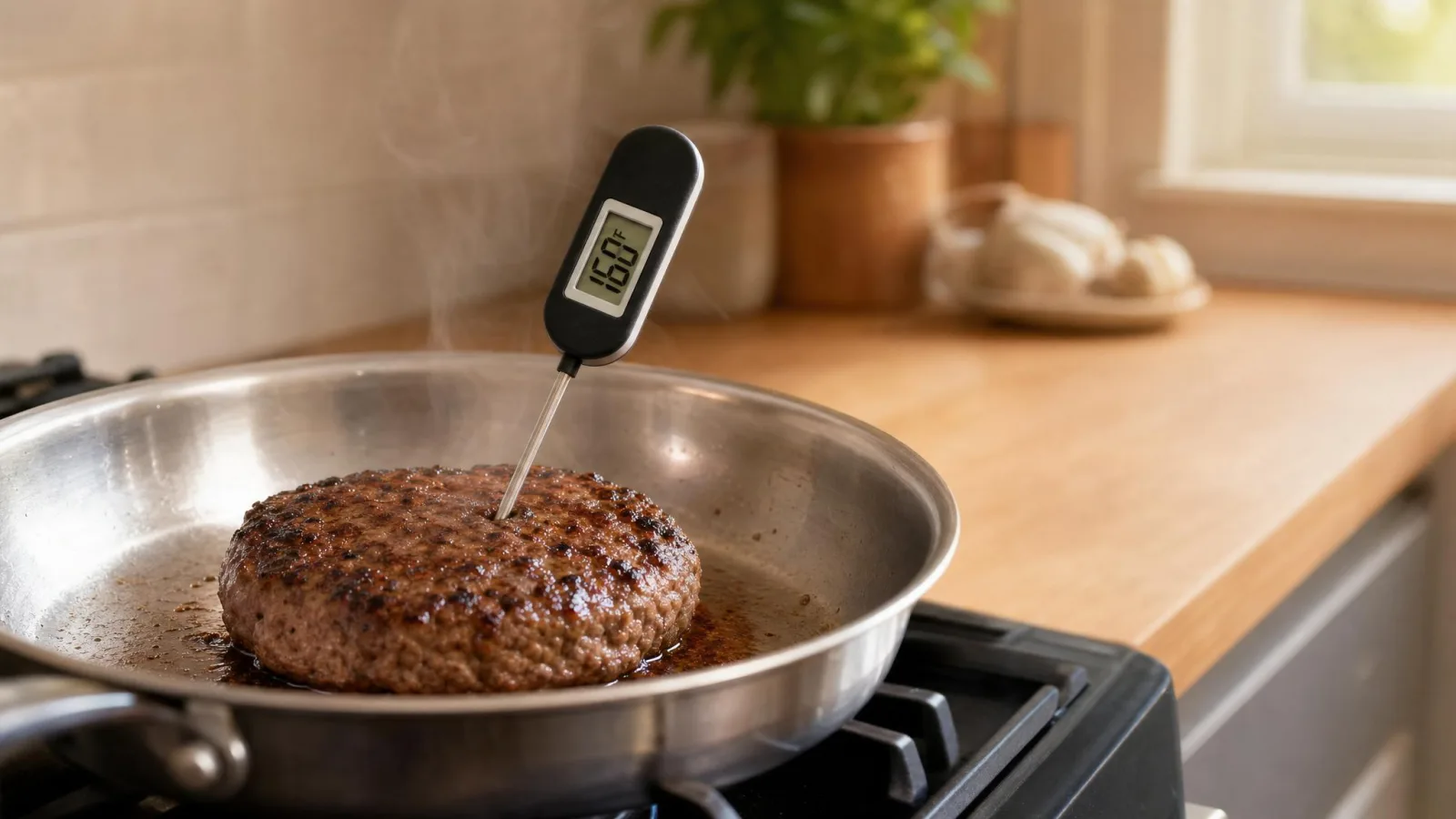
The protection is heat, and it is precise. The USDA says to cook ground beef to a safe minimum internal temperature of 160 degrees Fahrenheit, measured with a food thermometer, because color is not a reliable sign of doneness. Bacteria multiply fastest in the "Danger Zone" between 40 and 140 degrees, so cold food should stay cold and hot food hot. The NIDDK's prevention list for families is the same plain set of habits: cook beef to 160 degrees, avoid raw milk and unpasteurized juice, keep raw foods separate, wash hands well, and keep a child with diarrhea out of swimming pools. When a contaminated product is still on shelves, the government issues a recall. When the product is already gone, it issues a Public Health Alert instead, which is what the USDA did here because the beef kofta was no longer available for purchase.
Here is what stands out after years of these cases. None of this is new science. E. coli O157:H7 in ground beef, the danger of serving it undercooked to a young child, and the 160 degree fix have been understood for decades. When a child gets sick from a restaurant burger or kofta, it is almost never because the hazard was unknown. It is because a step meant to catch it did not. Responsibility for an illness like this sits with the businesses that grow, grind, sell, and cook the meat, the parts of the chain a parent ordering dinner cannot see or control. In this outbreak that chain is not a guess. Whole genome sequencing matched beef kofta samples produced at the supplier to the outbreak strain of E. coli O157:H7, according to the USDA. We say this as accountability, not blame. A family did nothing wrong by trusting a restaurant to cook a child's meal to a safe temperature.
What happened in the Kebab Shop outbreak
What started as grilled beef kofta on a restaurant menu ended with five people in the hospital. The California Department of Public Health linked an E. coli O157:H7 outbreak to the beef kofta, a seasoned ground beef, served at The Kebab Shop restaurant chain. CDPH is the state agency that led the investigation, working with local California health departments and federal partners at the USDA. As of May 19, 2026, while the investigation was open, nine people were infected, all of them California residents, with illness onset dates from March 27 through April 30. Six were children, five were hospitalized, two developed HUS, and no deaths were reported. No cases outside California were linked to the outbreak. The Kebab Shop voluntarily paused sales of the beef kofta at all locations on May 18, and CDPH said the risk of exposure was no longer ongoing.
The USDA traced the beef to a raw ground beef product made by Olympia Food Industries in Franklin Park, Illinois, and supplied to Kebab Shop locations in California, Texas, and Florida, though the illnesses were all in California. For the full timeline, recall status, and updates, see our Kebab Shop beef kofta E. coli outbreak page.
When an outbreak is traced to a product, the question of who along the chain is accountable follows close behind. Ron Simon & Associates filed the first lawsuit in this outbreak, on behalf of a child, identified by the initials K.G., who developed acute kidney failure and HUS after eating the beef kofta. The firm filed in the Superior Court of California, County of Orange, with co-counsel Gomez Trial Attorneys. Ron Simon & Associates is based in Houston and represents families nationwide. In California cases the firm works with local co-counsel, here Gomez Trial Attorneys, so the matter is handled by lawyers admitted in California.
What gets lost, and what is worth keeping
There is a reason one test matters twice over. A stool culture confirms whether this really is a Shiga toxin-producing E. coli infection, which is what tells a clinician to skip antibiotics and watch for HUS. That same sample, sent for whole genome sequencing, is also how a public health lab decides whether one child's strain is the strain behind an outbreak. It is the difference between an isolated stomach bug and a confirmed link to a recalled product, and that link is far easier to establish while the sample still exists than to argue from memory later.
When a child is the sick one, nobody is thinking about paperwork, and that is exactly why a few things slip away that are hard to recreate later. In the cases we have handled, the same items go missing again and again. A little effort now saves a lot of guessing later.
- Ask for the stool-test result, in writing. A confirmed culture showing the E. coli strain, and ideally a note that it was sent for whole genome sequencing, is what links one child's illness to a named outbreak. Once the sample is gone, that confirmation is hard to get back.
- Save anything that shows what was eaten and where. A receipt, a card or app statement, an online order, even a photo of the meal, and a note of who else ate it. Memories of which night and which dish fade within days, and the date matters because E. coli has a known incubation window.
- Write down a simple timeline while it is fresh. What the child ate, when symptoms started, when you sought care, and what each provider said. A few lines in your phone now beat reconstructing three weeks of a blur months later.
- Report the illness. In California, foodborne illness is reported through your county health department, which feeds the state investigation CDPH leads. Reporting is how one sick child becomes part of the count that identifies an outbreak.
When contaminated food causes that harm, more than one company in the supply chain can share responsibility. If you are weighing whether you have a claim, our page on legal help after a child's HUS walks through how these cases work, and you can read how we handle E. coli illness claims. A consultation is free, and you may want to act before your state's filing deadline passes.
Frequently asked questions
Can E. coli cause HUS in a child?
Yes. HUS is a complication that can follow an E. coli infection, usually the Shiga toxin-producing strains like O157:H7. The CDC reports that among children who develop HUS, about 8 in 10 have an E. coli infection behind it, and HUS is most common in children younger than 5.
Is ground beef safe to eat right now?
Yes, ground beef is safe when it is handled and cooked properly. Cook it to an internal temperature of 160 degrees Fahrenheit, measured with a thermometer, and check the USDA's recalls and alerts page for any product currently under warning. The specific beef kofta tied to the Kebab Shop outbreak was pulled from all locations on May 18, 2026.
Can cooking kill E. coli?
It can, and the number that matters is 160. Cooking ground beef to an internal 160 degrees Fahrenheit kills E. coli. The catch with ground beef is that grinding spreads any surface bacteria all the way through, so the inside has to hit that temperature too, not just the outside. Color is not a reliable guide, which is why a thermometer matters.
What does HUS feel like in a child?
HUS usually follows several days of diarrhea, often bloody. As it develops, a child may pee much less, look pale, bruise easily or show tiny red spots, and become very tired or hard to wake. The CDC treats these as emergency signs that warrant a call to the doctor or a trip to the ER.
How long after eating contaminated food do symptoms start?
For E. coli O157:H7, symptoms usually begin about three to four days after exposure (CDPH), and can appear anywhere from 2 to 8 days later, according to the USDA. Most people recover within a week, but a smaller number go on to develop HUS.
When should I take my child to the emergency room?
Go to the ER, or call your doctor right away, if a child has bloody diarrhea, signs of dehydration like little or no urine, or any of the HUS warning signs the CDC lists, including decreased urination, paleness, unexplained bruising, extreme tiredness, or reduced alertness.
Sources
- CDC: Hemolytic Uremic Syndrome (HUS)
- CDC: Symptoms of E. coli Infection
- CDC: Treatment of E. coli Infection
- CDC: About E. coli
- NIDDK (NIH): Hemolytic Uremic Syndrome in Children
- Cleveland Clinic: Hemolytic Uremic Syndrome
- National Kidney Foundation: Hemolytic Uremic Syndrome (HUS)
- Children's Hospital of Philadelphia: Hemolytic Uremic Syndrome in Children
- USDA Food Safety and Inspection Service: Ground Beef and Food Safety
- USDA FSIS: Public Health Alert for Beef Kofta Products Served at The Kebab Shop
- USDA Economic Research Service: Kidney damage responsible for 65 percent of illness costs from STEC O157 (2015)
- California Department of Public Health: News Release NR26-022
- Infectious Diseases Society of America: 2017 Clinical Practice Guidelines for Infectious Diarrhea (Shane et al.)
- Wong CS et al.: The Risk of the Hemolytic-Uremic Syndrome after Antibiotic Treatment of Escherichia coli O157:H7 Infections (NEJM 2000)
This article is general information, not legal or medical advice. If your child has bloody diarrhea or any warning sign above, call your pediatrician or go to the emergency room. For the official outbreak details, follow the CDC, the USDA, and the California Department of Public Health.